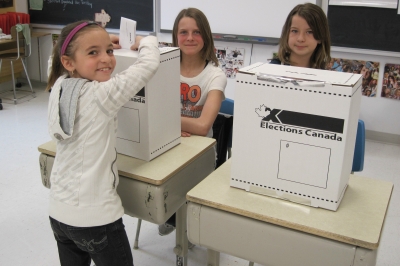
Grade 4-6 students at St. John School in Garson recently participated in a “Student Vote” program sponsored by Elections Canada which gave them the opportunity to experience the democratic process firsthand as well as practice the habits of informed and engaged citizenship. April 28th, 2011 was our designated “Student Vote” day and students took on the roles of Deputy Returning Officers, Poll Clerks and voters parallelling the adult electoral process. The exercise of a mock election proved to be a very empowering process and students are eagerly awaiting the election results both at the school and federal level.
Author: admin
Take Something Ordinary, and Make it Extraordinary!
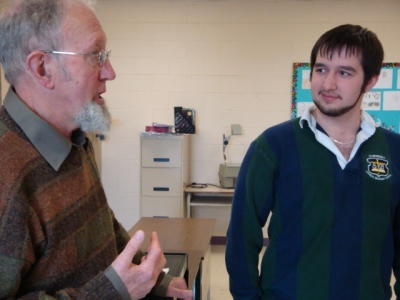
St. Benedict students’ attention was captured by Greater City of Sudbury’s Poet Laureate, Dr. Roger Nash, during his poetry workshop with senior English classes. He told them they can write about anything, and by doing so, keep a special memory alive. Dr. Nash demonstrated this fact by reading his poems about the family cat Genghis, and another about his childhood memory of his grandmother’s passion for playing piano; so vigorously it seemed to take flight. Roger Nash intrigued students with his explanations for the impetus behind his poems, which in turn inspired students to write their own poetry. His final advice was that through poetry one can, “take something ordinary, and make it extraordinary”.
Unique Intramural Sport at St. James Schools
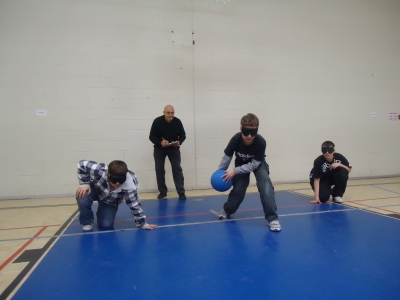
The grade 4 to 8 students at St. James Catholic School in Lively play organized goalball at lunch recess. A total of 27 teams participate in this game for the blind that is gaining in popularity around the world. The game was introduced to St. James school by Mr. Adriano Simonato, Specialist Teacher of the Blind and Partially Sighted.
The object of the game is to roll a rubber ball with bells inside past the opposing team. Each goalball team is made up of three players with each protecting their goal line. There is one center and two wings per team. The offensive team rolls the ball in an attempt to get the ball past the opposing three players. The defensive team listens for the approaching of the ball and attempts to prevent or block the ball from crossing the goal line. When a defending player gains possession, it is then his or her team’s turn to throw at the opposing team’s goal. The only time there is a stoppage of play is after a goal has been scored, or if the ball crosses a sideline. The ball is rolled back and forth with the offensive and defensive team alternating until time expires for the half. The game is played in two periods of 5 to 10 minutes each and the team with the most points wins. The game is played on a rectangular court, which is divided into two halves by a centre line. The goals, which are the same width as the court, are placed at each end.
There are three main rules associated with throwing the ball. First, a thrown ball must touch the floor of the court before passing over the highball (or centre) line. Secondly, a throw must take place within eight to ten seconds of coming under the control of the defending team. Passing can take place within that time. Thirdly, no player may take more than two consecutive throws for his team. A number of personal and team penalties maybe awarded for rule infractions. During the game, spectators must remain absolutely silent so that players can follow the direction of the ball. Spectators can applaud or cheer after a goal is scored and at the end of each half. Each player has to wear a blindfold regardless of the degree of visual impairment. Each player has the option to wear elbow pads, kneepads, hip pads and face protection. There are women’s and men’s teams with no variations in equipment or rules.
Too many people who are visually impaired or blind usually do not have many opportunities to be involved in team sports and physical activity. According to Simonato, “one of the great benefits of goalball is that it promotes teamwork and cooperation among participants. Also, because goalball can be played by individuals who are sighted and visually impaired together, it acts as a medium for breaking down barriers. As a result it helps promote awareness within the school community regarding what individuals who are visually impaired can do”.
An “ Egg-citing” Day for Junior Kindergarten Students
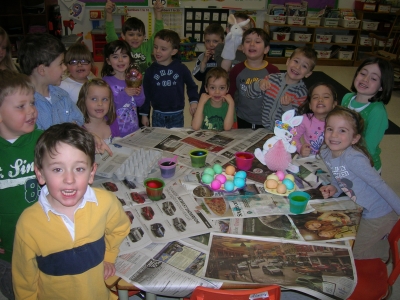
The junior kindergarten class at St.Francis School prepared a traditional symbol to celebrate Easter and the season of spring. Students eagerly dyed their Easter eggs using primary and secondary colours. The students were in awe of the vibrant colours which appeared on the eggs.
SCDSB Supports the Gift of Life
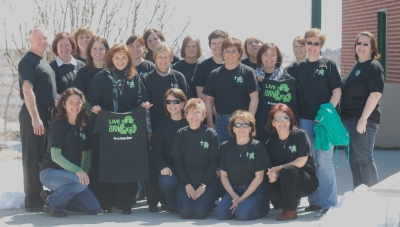
Staff from the Catholic Education Centre for the Sudbury Catholic District School Board showed their support for their Board’s Gift of Life initiative recently as many sported their t-shirts with the logo Live Life then Give Life. These t-shirts are available for purchase ($10 each) at any of the Sudbury Catholic Secondary Schools as they are being sold by the schools’ student senate students in support of the Gift of Life.
St. Anne School Kindergarten Imaginations Build Green
The littlest hands can produce the most amazing things. Danika Gray, on the left, and her building partner show this by proudly displaying their finished product after a morning of inquiry and problem solving at St. Anne School in Hanmer. Junior and Senior Kindergarten French Immersion students within the Early Learning Kindergarten Program worked in teams, using recycled materials, to design and build a house, complete with some fancy options like doors, windows, chimneys, and even a fireplace. No project was too big or small! Who knows? These may be the architects of tomorrow!
MMA’s Envirothon Teams Take Top Spots
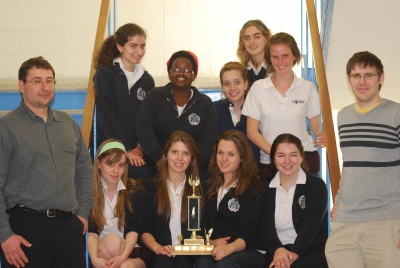
Students from Marymount Academy walked away from the region’s ninth annual Sudbury regional Envirothon competition as winners. In fact, the school’s two entries took the top two spots in this year’s competition. The Envirothon is a hands-on environmental program for students in Grades 9-12 and creates awareness about environmental issues in a variety of subject areas. Teams of 5 students prepare for the competition by intensely studying the various topics as well as preparing themselves to put together a project at the competition related to a different environmental issue -which is chosen every year. This year’s topic was “Protection of Groundwater Through Urban, Agriculture and Environmental Planning”.
Jason Weiler, the Marymount teacher in charge of the team has been involved with the Envirothon for the past 6 years and his teams have taken the top spot for 5 of those years. “It is a real credit to my students who continue to embrace the environment,” Weiler stated. “They are extremely dedicated to the team, and to being stewards of the earth, and am extremely proud of their achievements.”
Teammate Jenna Floyd (Grade 10) who is on the first place team was thrilled with their win and was excited for the upcoming competition. “It was a fantastic learning experience for us,” Floyd said. “It has really given us a chance to take our academics outside the classroom and embrace learning in a whole new environment.”
Both teams from Marymount will be moving on to the Provincial competition which will be held May 5th – 8th at the Tim Horton Onondaga Farms in St. George, Ontario.
St. James Learns Traditional Art of Pysanky
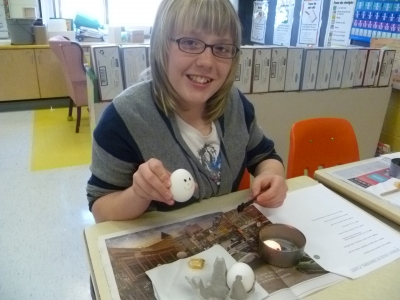
During the Easter season, the grade 6,7and 8 French Immersion class from St. James Catholic School in Lively welcomed Jan Buley, a professor at Laurentian University who loves to teach the art of Pysanky–Ukrainian Easter eggs. These eggs are a traditional craft in Ukraine, with a history of thousands of years. Pysanky are decorated in many steps using a kistka, beeswax and several colours of dye. The students loved the experience and learned a very short but interesting lesson on the traditional craftof egg decorating and Ukrainian culture. The Ukrainian eggs that were created by the students were amazing and beautiful!
Bishop Alexander Carter Students Fight World Hunger
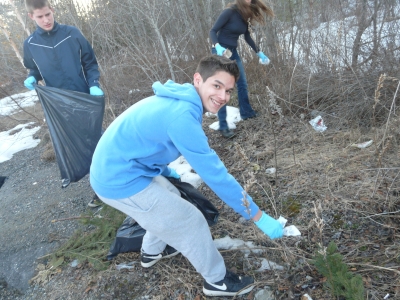
Students from Bishop Alexander Carter did their part in fighting world hunger this past month by taking part in a 30 hour famine.The group of 90 students formed groups of 12 to compete in several character, team, and global awareness building activities such as a community clean-up, a scavenger hunt, and several art activities. Students were even lucky enough to have a guest speaker, on behalf of Development and Peace, from Sierra Leone. While students were hard at work on a full length motion picture movie being produced by the specialist high skills major class, teachers taking part were also hard at work making a chocolate and vanilla marble cake with crisp maple bacon to garnish – a treat for students after the famine was over, and that is when the hunger began to set in. But determined to make a difference and stick to the goal, students fought the hunger knowing that it would all be over after the 30 hours.
Wrapping up the events before the big luncheon, students and staff took part in a morning prayer service. “We all really had a good time, and we met so many new interesting people,” stated Kelsey Blais , Bishop Alexander Carter student. “At the end of the day, it was great to know that each and everyone of us is changing someone’s life, maybe not forever, but even for just a second, that’s what counts.” Raising well over $1 400, students were proud of their efforts and knew that they had made a difference not only in their community, but in the world as well.